Sharikov’s reversion to a dog
The Heart of a DogSharikov’s reversion to a dog is the hidden outcome of the final struggle in Preobrazhensky’s apartment: the humanized dog disappears, and, ten days later, the professor produces Sharik alive in canine form. The reversal resolves the immediate threat posed by Sharikov but does not settle the questions of violence and responsibility; the police investigation instead exposes how the household’s silence and the professor’s account keep the transformation’s cause concealed.
From Experiment to Human Identity
The subject of the experiment was initially recorded as a male mongrel about two years old, named Sharik. After receiving a piece of sausage from Preobrazhensky, the dog accepted the name Sharik and responded with gratitude to the man he regarded as his rescuer. The name thus first belonged to an animal whose attachment was formed through a concrete act of care.
The experiment altered that identity. The man who emerged insisted on choosing a name, gave the form Toligraph Poligraphovich, and then declared that he would use his real name. With Shvonder’s help, the identity became Poligraph Poligraphovich Sharikov: a name made legible to administrative institutions as well as to the household. The later police charge describes him as a sub-department controller in the City of Moscow Cleansing Department. His return to dog form therefore reverses more than a bodily transformation: it unsettles a human identity that had acquired a name, job title, and official standing.
The Final Struggle and Its Aftermath
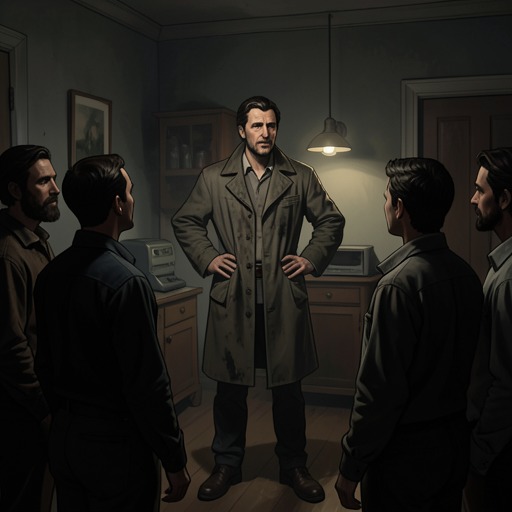
The reversion follows a confrontation in which Sharikov, claiming a right to remain in the apartment, draws a revolver on Bormenthal. Bormenthal overpowers him, and the scene ends with Sharikov unconscious under the doctor’s control. The narrative gives no direct account of the operation or other procedure that follows. Instead, it moves from this violent struggle to a period of locked doors and silence, leaving the exact means and timing of the reversal unshown.
The household’s subsequent conduct sustains that gap. Bormenthal locks the front and back doors and the passage between the corridor and hall, telling the two women that they must not be disturbed. Neighbours later report that lights remained on in the consulting room; a more uncertain account has Bormenthal burning one of the blue-bound notebooks containing the professor’s medical notes. The account marks the destruction of records as reported rather than fully verified, but the contrast is pointed: the experiment’s documentary traces may be disappearing just as its outcome is concealed.
The Police Investigation and the Reappearance
Exactly ten days after the struggle, the criminal police arrive. They charge Preobrazhensky, Bormenthal, Zinaida Bunina, and Darya Ivanova with murdering Sharikov, identified in the charge as a sub-department controller. The allegation makes the missing man’s bureaucratic identity the basis for a criminal case, even though the police have not yet seen what became of him.
Preobrazhensky answers by denying that anyone has killed Sharik and referring to him as his dog. When the investigator objects that the missing person had been a man, the professor replies that speech alone did not make him one. He then has Bormenthal produce Sharik. The dog enters first on his hind legs, drops to all fours, and later sits upright in an armchair. Bald patches and newly grown coat, along with a crimson scar on his forehead, reveal a body in transition rather than an ordinary, unaltered animal. The policemen’s astonishment turns the reappearance into public evidence, although it does not explain the hidden process that brought it about.
Explanation and Unresolved Responsibility
Asked why the experiment failed, Preobrazhensky tells the police that science has not yet found a way to turn animals into people and that his attempt was unsuccessful. He explains that Sharikov talked and then began reverting to a primitive state, calling the process atavism. Sharik’s brief bark from the chair immediately complicates the professor’s clinical explanation: the returned animal still displays the capacity for speech, even as the scene presents him in canine form.
The ending confirms the reversal but limits what can be known about it. The reader sees the result and hears the professor’s account, while the operative events remain offstage; the possible burning of the case notebook further clouds the documentary record. The episode closes the experiment’s arc by restoring Sharik as a dog, yet it leaves the police charge, the household’s actions, and the boundary between animal and human identity unresolved. The return is at once a practical end to Sharikov’s presence as a threat and an unsettling demonstration that the transformation could be reversed without making its consequences disappear.